N-central Zero-Day: What MSPs and Their Clients Need to Know
Learn about the 4EverAble2Shell and Agent2Shell exploits targeting N-central, how they work, and what to do right now.
What Is This Threat?
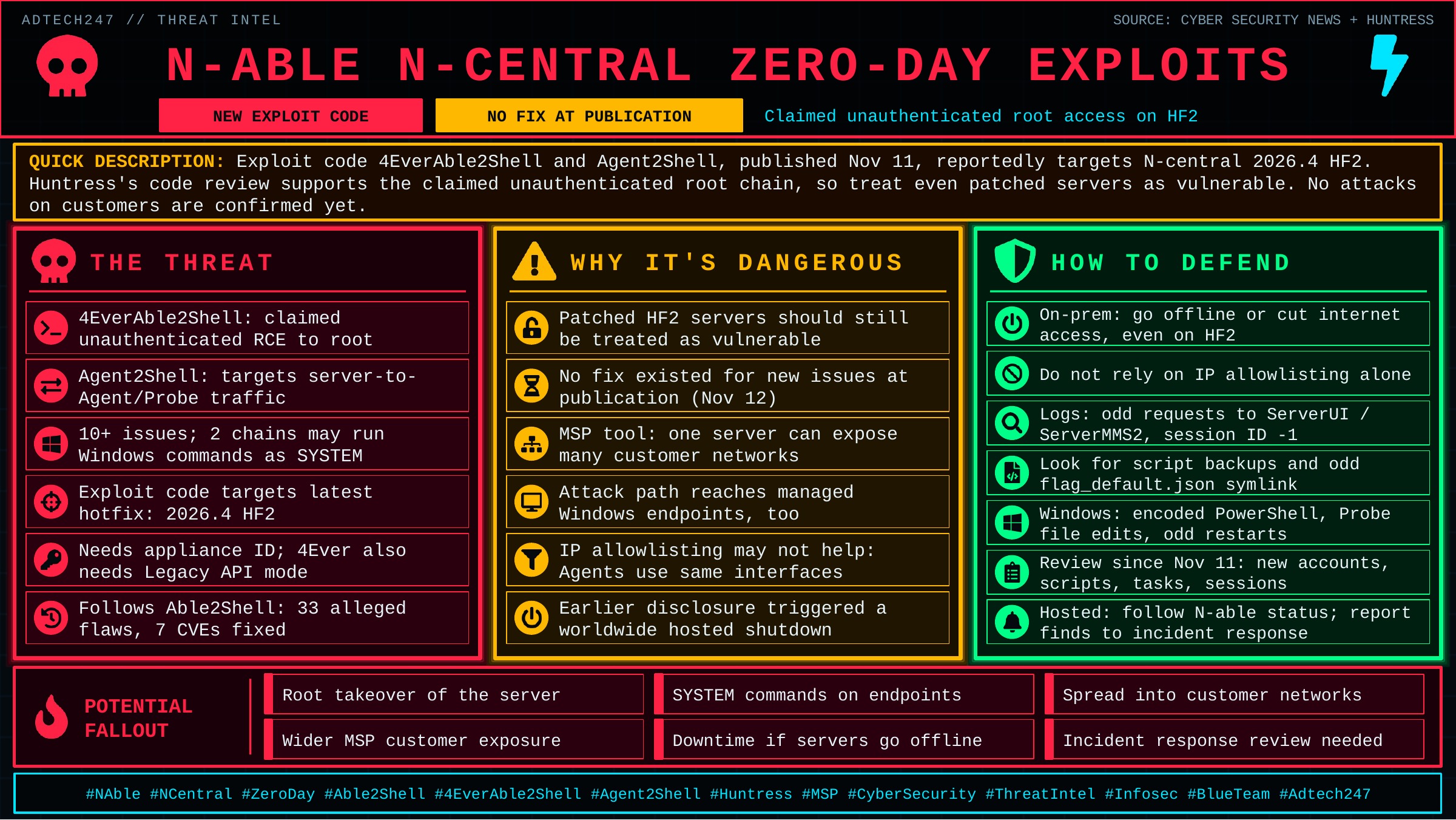
In mid-November, security researchers released exploit code targeting N-able's N-central platform—a remote management tool used by managed service providers (MSPs) to oversee customer networks. Two exploits were publicly disclosed: 4EverAble2Shell and Agent2Shell.
The key concern: these exploits reportedly work even on patched versions, and they don't require authentication. That means an attacker on the internet could potentially take control of an N-central server without a valid username or password.
Why this matters: if an MSP's N-central server is compromised, attackers could reach many client networks at once. One server becomes a springboard to dozens of businesses.
How the Attacks Work
4EverAble2Shell targets the N-central appliance itself. According to researchers, it chains together multiple flaws to gain root-level access—the highest level of control on a Linux or appliance-based system. The exploit reportedly requires Legacy API mode to be enabled, but the real danger is that it needs no login.
Agent2Shell is different. It targets the communication channel between N-central and the Windows machines it manages (called Agents or Probes). Researchers found 10+ underlying vulnerabilities in this traffic. Some of these could let attackers run commands on managed Windows devices with SYSTEM privileges—again, the highest level of access.
Both exploits were public knowledge as of November 11. When researchers published their detailed findings on November 12, no patches were available yet.
Warning Signs to Watch For
If you run N-central on-premises or manage clients using it, look for:
- Odd log entries to ServerUI or ServerMMS2 with session ID -1 (indicates unauthenticated access attempts)
- Encoded PowerShell commands showing up in Windows event logs on managed devices
- Unexpected changes to N-central Probe files on your servers
- Service restarts you didn't authorize, especially on N-central or managed machines
- Unusual outbound traffic from your N-central server to unknown IP addresses
- Any suspicious activity dating back to November 11 or later
Note: many of these indicators come from code analysis by researchers, not from confirmed real-world attacks. Still, they're worth checking.
How to Protect Yourself
Immediate steps:
- Take N-central offline or disconnect it from the internet if you run it on-premises. Yes, even if you've applied the latest hotfix. Researchers advised this as a precaution.
- Disable Legacy API mode if you have it enabled and the latest patches support that change.
- Don't rely on IP allowlisting alone. Firewalls are helpful, but they're not a complete fix for code-level flaws.
- Review your logs for the warning signs listed above, going back at least two weeks.
- Check for unauthorized agents or probes in your N-central console—look for devices you don't recognize.
- If you're a hosted N-central customer, follow N-able's official status updates and patch notifications closely.
Medium-term:
- Apply patches as soon as they're released and tested in your environment.
- Consider isolating N-central on a separate network segment so a breach doesn't automatically spread to all your clients.
- Review who has admin access to N-central and why.
- Enable all available logging and monitoring on N-central itself.
The 30-Second Version
- Simple: Researchers found unauthenticated code-execution flaws in N-able's N-central management tool.
- Meaningful: One compromised N-central server can give attackers access to many client networks at once.
- Actionable: Take N-central offline or disconnect it from the internet immediately; review logs for unauthorized access since November 11.
- Relevant: This affects MSPs and anyone whose network is managed via N-central.
- Timely: Patches may not exist yet, so isolation is your best immediate defense.
FAQ
Are my managed Windows devices at risk if N-central is patched?
Yes, possibly. Agent2Shell targets the communication between N-central and your Windows machines, not just N-central itself. The flaws in that traffic may still exist even after you patch the server. Review your Windows logs for the warning signs mentioned above, and assume you should audit any managed device that connects to N-central.
How do I know if I'm affected?
You're potentially affected if: - You run N-central on-premises, or - Your IT vendor or MSP uses N-central to manage your network, or - You're an MSP with N-central customers.
Contact your MSP or N-able directly to confirm your version and patch status. Hosted customers should check N-able's status page.
Is this a targeted attack or a widespread threat right now?
As of the researchers' report, no confirmed attacks on customer servers were documented. However, exploit code is now public, so the risk of real-world attacks is real. Treat this as a credible threat and act now rather than waiting for proof of compromise.
What to do next: If you manage N-central or use an MSP, contact them today to confirm your patch status and isolation plan. Don't wait for an incident to happen.
Get a lesson like this every weekday.
Daily threat briefs, mini-lessons and infographics for defenders, small businesses and anyone who wants to stay a step ahead.
Keep reading
-
How a Router Failure Crashed the FAA: Lessons for Your Network
Learn why a faulty router brought down FAA systems, and how to prevent similar infrastructure failures in your business through testing and rollback planning.
ThreatIntel -
Notepad++ 8.9.9: Six Vulnerabilities Patched—What You Need to Do
Learn about six security flaws in Notepad++ affecting Windows message handling and plugins, and how to protect your systems today.
ThreatIntel -
How AI-Powered Hacking Exploits Work & What to Watch For
Learn how attackers use AI agents to automatically find and exploit software vulnerabilities faster than ever—and what your business can do about it.
Threat Detection